Everyday Play Ideas to Support Your Child at Home
Supporting your child’s development at home does not need to involve expensive therapy equipment or carefully planned activities.
Some of the most useful opportunities for children to practise movement, coordination, independence and problem-solving can be found in everyday play and family routines.
The key is not to make every activity feel like work. Start with something your child already enjoys, keep the experience low-pressure and adjust it to suit their interests, energy and sensory preferences.
Here are seven simple ideas you can try using items you may already have at home.
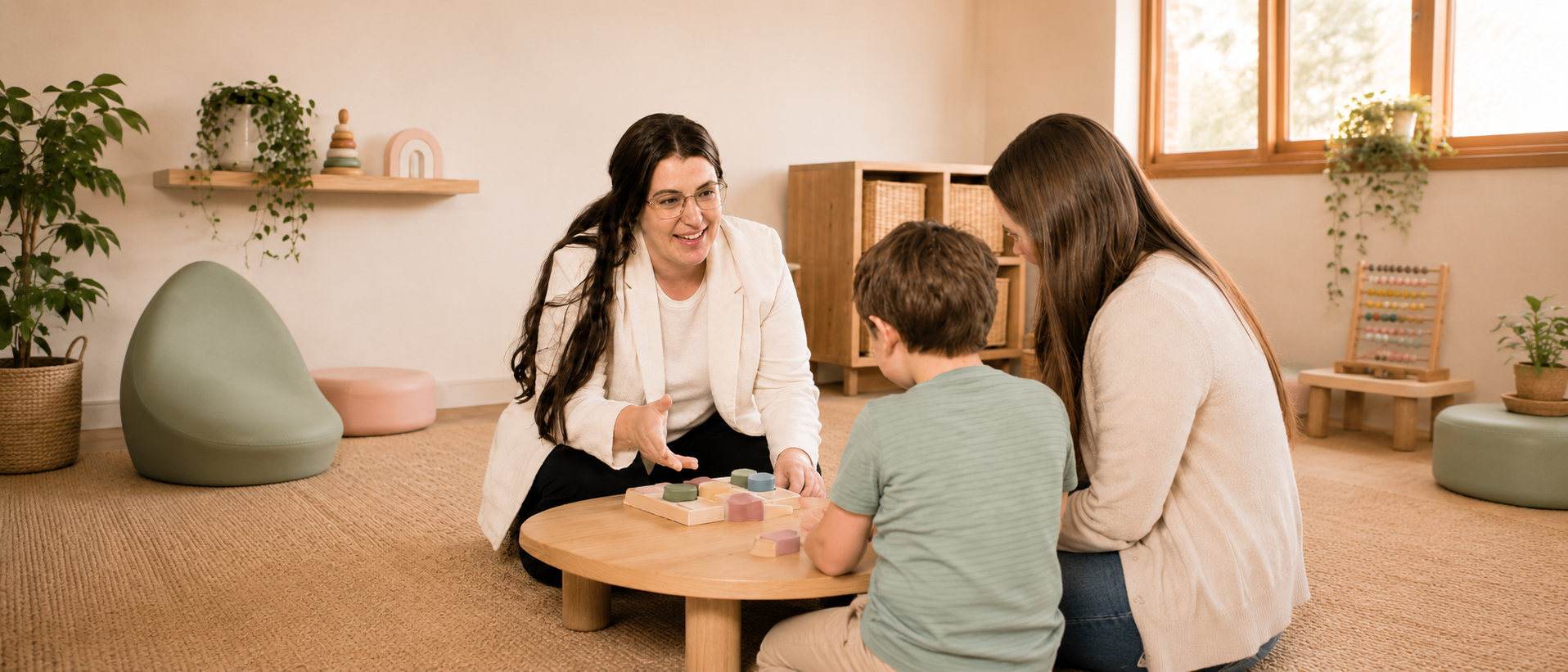
Paediatric occupational therapist supporting a child and parent during a play-based activity in a warm, welcoming therapy space.
Create a household delivery game
Give your child a small basket, bag or toy trolley and ask them to deliver safe household items from one room to another.
They might deliver:
Socks to the bedroom
Tea towels to the kitchen
Soft toys to different family members
Books to a reading corner
Plastic cups to the table
Carrying, pushing and pulling objects can provide opportunities to practise whole-body coordination, planning and following simple directions. It can also help children participate in household routines in a playful way.
Make it easier: Use a lightweight basket and deliver one item at a time.
Add a challenge: Create a picture list, include several destinations or ask your child to remember two items at once.
2. Set up a cushion pathway
Use cushions, folded blankets, masking-tape lines or sturdy stepping spots to create a pathway across the floor.
Your child could:
Step between the cushions
Crawl through part of the course
Walk along a tape line
Carry a favourite toy to the finish
Move like different animals
Pause at different stations
This type of play may provide opportunities to practise balance, body awareness, movement planning and coordination.
Let your child help design the course where possible. Children often have creative ideas about where the path should go and what should happen along the way.
Always check that the area is safe, stable and clear of sharp furniture or other hazards.
3. Invite your child to help in the kitchen
Everyday kitchen tasks can offer meaningful ways to practise hand skills and independence.
Depending on your child’s age and abilities, they might help with:
Pouring pre-measured ingredients
Stirring a mixture
Washing fruit or vegetables
Using tongs to move food
Spreading a soft topping
Opening and closing containers
Wiping the table
Carrying lightweight items to the bench
There is no need for the finished product to look perfect. The goal is participation, shared time andgiving your child an opportunity to try.
Choose tasks that are safe and manageable, and provide as much assistance as your child needs.
4. Make a peg or tong treasure hunt
Hide larger, age-appropriate objects around a room or outdoor area and invite your child to collect them.
You could use:
Large craft pom-poms
Pegs
Toy animals
Building blocks
Puzzle pieces
Rolled-up socks
Your child can pick the objects up with their hands, kitchen tongs or a scoop and place them into a container.
This activity may provide opportunities to practise hand strength, hand-eye coordination, visual scanning and using both hands together.
Make it easier: Place the items where they are clearly visible and allow your child to use their hands.
Add a challenge: Sort the items by colour, match them to pictures or collect them in a particular order.
Avoid small objects when working with younger children or children who may place items in their mouths.
5. Turn drawing into whole-body play
Drawing does not always need to happen while sitting at a table.
Try attaching a large piece of paper to a wall, easel or outdoor fence. Your child could use crayons, chalkor washable paint to create:
Roads for toy cars
A treasure map
A picture of their favourite character
Large circles and lines
A family mural
A menu for pretend play
Working on a vertical surface changes the position of the arms and body and can make drawing more engaging for some children.
It is also fine if your child prefers making marks, stickers, stamps or collage rather than traditional drawing. The activity should reflect their interests rather than focusing on producing a particular result.
6. Build a comfortable reset space together
A comfortable space can give a child somewhere to pause when they want less noise, movement or interaction.
Rather than deciding what a “calming corner” should contain, involve your child in choosing what feels comfortable for them.
They might select:
A cushion or beanbag
A soft blanket
Books
Headphones
A favourite toy
Drawing materials
A drink bottle
A small tent or covered space
A visual card they can use to request quiet time
Not every child finds the same things calming. Some children prefer stillness, while others regulate through movement, music, pressure or having something to do with their hands.
The space should be available as an option rather than used as a punishment or a place the child is required to stay.
7. Use pictures to make a routine easier to follow
Pictures can help make everyday routines more predictable and reduce the amount of verbal information a child needs to remember.
A simple visual sequence might show:
Put on pyjamas
Brush teeth
Choose a book
Get into bed
You can use photographs, drawings, printed pictures or words, depending on what is most meaningful for your child.
Some children may like moving each picture into a “finished” pocket as they complete the routine. Others might prefer checking items off or choosing which task comes first.
Visual supports should help the child understand what is happening. They should not be used to demand perfect compliance or remove reasonable choice from the routine.
Keep it playful and manageable
You do not need to complete all of these activities or practise them every day.
A few enjoyable minutes within an existing routine may be more useful than a longer activity your child does not want to join. Some days your child may be interested, while on other days they may need rest, movement, connection or time with a familiar activity.
It can help to:
Start with your child’s interests
Offer choices
Keep instructions simple
Demonstrate rather than repeatedly explaining
Notice signs that your child has had enough
Change the activity when something is not working
Celebrate participation rather than perfection
The aim is not to make home feel like a therapy session. It is to find comfortable and meaningful ways for your child to participate in play and everyday family life.
When might occupational therapy help?
It may be helpful to speak with an occupational therapist when differences in movement, coordination, sensory processing, emotional regulation or daily living skills are making everyday participation difficult for your child or family.
An occupational therapist can help explore what may be contributing to the difficulty and work with your family to develop practical strategies suited to your child’s strengths, preferences and routines.
Frequently asked questions
Do I need special equipment to try these activities?
No. Many useful play experiences can be created with cushions, baskets, pegs, paper, kitchen utensilsand other safe household items.
How long should an activity last?
There is no set amount of time. For some children, five minutes may be plenty. Follow your child’s engagement and stop or change the activity when they appear tired, uncomfortable or no longer interested.
What should I do if my child does not want to participate?
Avoid forcing the activity. You might demonstrate it yourself, offer a different choice or return to it another day. It is also worth considering whether the activity feels too difficult, unpredictable, uncomfortable or unrelated to your child’s interests.
Are these activities suitable for every child?
Every child has different abilities, sensory preferences, interests and support needs. Activities should always be adapted to the individual child and supervised in a way that is appropriate for their age and development.
How can I find out whether occupational therapy may be helpful?
Lily offers a free 15-minute conversation for parents and carers who would like to discuss their child’s needs and determine whether her occupational therapy services may be the right fit for their family.
These suggestions provide general information only and are not a replacement for individualassessment or advice from a qualified health professional.